Dried Sea Moss: 5 Reasons Global Brands Choose This Sea Moss Raw Material
Dried sea moss is becoming an increasingly important sea moss raw material for global wellness brands seeking stability, flexibility, and scalability in product development. As demand continues to rise across supplements, functional foods, and personal care products, manufacturers are prioritising raw materials that can support long-term growth and consistent production.
Unlike ready-to-consume formats, dried sea moss provides greater control over processing, formulation, and supply chain management. This makes it particularly valuable for B2B buyers, private label brands, and manufacturers who need reliable input materials for large-scale production. In a competitive market, having a stable and adaptable raw material is essential for maintaining product quality and operational efficiency.
What Is Dried Sea Moss?
Dried sea moss is raw sea moss that has undergone a controlled cleaning and dehydration process to reduce moisture content while preserving its natural nutrients and structural integrity. This process significantly extends shelf life and allows the material to be stored for extended periods without requiring refrigeration.
As a versatile sea moss raw material, it can be rehydrated and further processed into various product formats such as gels, powders, extracts, and capsules. This adaptability makes dried sea moss highly suitable for manufacturers who want to customize their formulations based on specific market demands.
In addition, dried sea moss offers better inventory management and production planning, especially for international businesses that rely on consistent supply chains.
Types of Dried Sea Moss Available
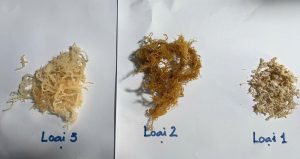
To meet different production requirements, dried sea moss is available in several grades, each defined by variations in moisture content, appearance, and processing level. These differences allow buyers to choose the most suitable type based on their manufacturing needs, product specifications, and market positioning. Selecting the right grade can significantly improve production efficiency and final product consistency.
Type 1 – Standard Export Grade
This type of dried sea moss contains natural salt residue and maintains a moderate moisture level of approximately 25–30%. It typically has a white or slightly opaque appearance and represents a balance between cost efficiency and product stability.
With a shelf life of up to 24 months and standard packaging of 1kg per bag, this type is widely used for bulk export and general processing applications. It is particularly suitable for buyers who prioritize affordability while maintaining acceptable quality standards.
Type 2 – Cleaned Grade (No Salt)
This variation undergoes additional processing to remove salt, resulting in a cleaner and more refined raw material. It maintains a similar moisture level (25–30%) but features a darker yellow tone and improved purity.
Due to its cleaner profile, this type is often preferred for premium product lines where ingredient quality and consistency are critical. It is also packaged in 1kg units and offers a shelf life of up to 24 months, making it a strong option for brands focused on higher-end positioning.
Type 3 – Semi-Wet Raw Material
This type has a significantly higher moisture content of approximately 60–70%, giving it a softer texture and lighter yellow appearance. Because of this higher moisture level, the shelf life is shorter, typically around 12 months.
It is commonly packed in 2kg units and is suitable for applications that require faster processing or minimal rehydration. This format can be advantageous for manufacturers who want to reduce processing time while maintaining product functionality.
5 Key Benefits of Dried Sea Moss
Long Shelf Life
One of the most significant advantages of dried sea moss is its extended shelf life. By reducing moisture content, the risk of microbial growth and spoilage is minimized, allowing the product to remain stable for long periods under proper storage conditions.
This is especially beneficial for international trade, where shipping times and storage durations can vary significantly.
High Flexibility for Processing
As a flexible sea moss raw material, dried sea moss can be transformed into a wide range of products depending on the processing method used. Manufacturers can create gels, powders, capsules, or beverages tailored to specific consumer preferences
👉 Related article: Sea Moss Gel Production Process
This flexibility enables brands to innovate and quickly adapt to changing market trends.
Cost-Effective for Bulk Buyers
Dried sea moss is generally more cost-efficient compared to processed formats. It reduces transportation weight, minimizes storage requirements, and allows manufacturers to control production costs more effectively.
For large-scale buyers, this translates into better margins and more competitive pricing in the market.
Easy to Transport and Store
Due to its lightweight and stable form, dried sea moss is easier to transport across long distances. It does not require refrigeration, which simplifies logistics and reduces shipping costs.
This makes it particularly suitable for export-oriented businesses and global distribution networks.
Retains Natural Properties
Despite the dehydration process, dried sea moss retains many of its natural nutrients, including essential minerals and bioactive compounds. When properly rehydrated and processed, these properties can be effectively restored.
This ensures that the final products maintain their functional value and nutritional appeal.
Common Uses of Dried Sea Moss
Dried sea moss is widely used across multiple industries thanks to its versatility and functional properties. It serves as a key ingredient in:
• sea moss gel production for direct consumption
• dietary supplements such as capsules and powders
• functional beverages and smoothies
• skincare and cosmetic formulations
This wide range of applications highlights its value as a sea moss raw material, suitable for both food and non-food product development
Why Many Brands Prefer Dried Sea Moss
Many global wellness brands prefer dried sea moss because it offers a strong balance between cost efficiency, flexibility, and consistent quality. It allows manufacturers to maintain control over their production processes while ensuring reliable results across different batches. This level of control is especially important for brands scaling their operations in competitive markets.
According to the Food and Agriculture Organization, seamoss is becoming an increasingly important raw material in the global food and nutrition industry, driven by rising demand for natural and functional ingredients.
Source: https://www.fao.org/home/en
Conclusion
Dried sea moss has established itself as a preferred sea moss raw material for global wellness brands due to its long shelf life, versatility, and cost efficiency. It enables manufacturers to maintain control over production while supporting scalable and efficient operations.
With multiple grades available and a wide range of applications, dried sea moss offers a reliable solution for product development across industries. As demand for natural and functional ingredients continues to grow, it will remain a key component in the future of wellness innovation.