

Sea Moss Gel and Fruit Compatibility: Why Not Every Fruit Works Well in Stable Formulas
Creating a successful sea moss gel formulation involves much more than simply blending fruit into a sea moss base. While fruit can improve flavor, color, and consumer appeal, not every ingredient works well with the natural structure of sea moss gel.
Different fruits contain different levels of:
- natural acids
- enzymes
- sugars
- water content
These factors can directly affect sea moss gel texture, viscosity, cold storage stability, and long-term product consistency.
As demand for functional wellness products continues growing, brands are increasingly focusing on ingredient compatibility rather than flavor alone. A visually attractive formula may still become unstable if the fruit profile negatively affects the gel structure over time.
Why Fruit compatibility matters in Sea Moss Gel Formulation
A stable sea moss gel formulation depends heavily on the interaction between sea moss polysaccharides and added ingredients.
Sea moss naturally contains compounds such as carrageenan, which help create the gel structure and smooth consistency commonly associated with premium sea moss products. However, certain fruits may interfere with this structure depending on their chemical composition.
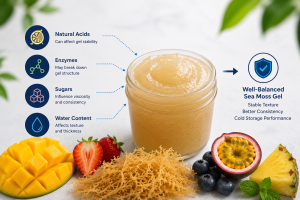
For example:
- highly acidic fruits may weaken gel stability
- enzyme-rich fruits may affect texture consistency
- excess water content may dilute viscosity
- strong aroma compounds may over power the sea moss base
This is one reason why some fruit blends appear stable initially but gradually separate, soften, or lose consistency during refrigerated storage.
Rather than selecting fruits only based on trend or color appeal, manufacturers increasingly evaluate ingredient compatibility as part of long-term product development.
You can also explore our related article about sea moss gel texture explained to better understand how stabilizing ingredients and formulation balance support texture consistency.
Natural Acids can influence Gel stability
One important factor in stable sea moss gel development is acidity.
Many fruits naturally contain organic acids that contribute freshness and flavor. However, when acidity levels become too strong, they may gradually affect the natural gel network formed by sea moss polysaccharides.
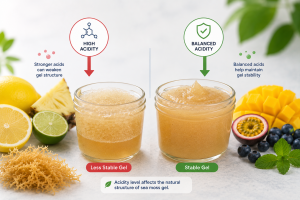 This can lead to:
- thinner gel texture
- reduced viscosity
- increased water separation
- lower stability during refrigeration
Balancing acidity is especially important for products designed for commercial distribution or extended cold storage.
In modern food formulation, acidity control is commonly used to improve product consistency and shelf-life performance across refrigerated functional foods and beverages.
According to Food and Agriculture Organization, ingredient interactions and formulation stability remain important considerations within processed food systems.
Water content affects Texture and Consistency
Another important challenge in sea moss gel formulation is managing water balance.
Some fruits naturally contain very high moisture levels. While this may create a refreshing flavor profile, excess water can dilute the gel structure and reduce overall product consistency.
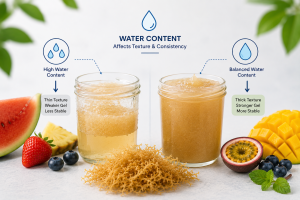 Over time, this may contribute to:
- weaker texture
- reduced thickness
- faster separation
- unstable cold storage performance
Because sea moss gel products are typically refrigerated, maintaining water balance becomes essential for preserving texture throughout transportation, storage, and daily consumer use.
This is also why many premium sea moss manufacturers perform repeated testing before finalizing a scalable formula.
At Seamoss Vietnam OEM solutions, formulation development focuses not only on flavor but also on long-term texture performance for retail and private label applications.
Flavor harmony is just as important as Texture
A successful stable sea moss gel product should maintain balance between flavor and natural sea moss characteristics.
Some fruits create strong aroma profiles that completely over power the marine base of sea moss. Others may provide attractive color but fail to support long-term formulation stability.
As wellness consumers increasingly look for cleaner and more natural product experiences, brands are placing greater emphasis on balanced formulations rather than artificial intensity.
Effective product development often requires optimizing:
- flavor harmony
- texture stability
- ingredient compatibility
- refrigeration performance
- manufacturing scalability
This process typically involves multiple testing stages before a final formula becomes commercially viable.
You can also read our related article about why sea moss gel needs refrigeration to understand how cold storage affects freshness and product stability.
Why formulation testing matters for OEM and private label production
For brands entering the wellness market, a scalable sea moss gel formulation must remain stable not only in small batches but also during larger production cycles.
This is especially important for:
- wholesale distribution
- OEM manufacturing
- private label expansion
- international cold-chain logistics
A formula that performs well in small handmade batches may behave very differently at larger production scale if ingredient interactions are not properly optimized.
Because of this, many modern manufacturers invest heavily in testing ingredient ratios, processing conditions, and storage behavior before commercialization.
According to World Health Organization, food quality management and formulation stability are important components of broader food safety and product consistency practices.
Seamoss Vietnam — Supporting Scalable Sea Moss Gel Solutions
At Seamoss Vietnam, we focus on developing private label sea moss gel and OEM solutions designed for modern wellness markets.

Our formulation approach prioritize:
- stable texture performance
- balanced fruit compatibility
- refrigeration stability
- scalable production consistency
- natural sea moss characteristics
As global demand for refrigerated wellness products continues growing, formulation quality and ingredient compatibility are becoming increasingly important across both retail and B2B markets.
Conclusion
Not every fruit works well inside a sea moss gel formulation. Acidity, enzymes, sugar levels, and water content can all influence texture stability, cold storage performance, and long-term consistency.
Creating a successful formula requires more than stronger flavor or brighter color. True product quality comes from balancing compatible ingredients while preserving the natural structure of sea moss itself.